
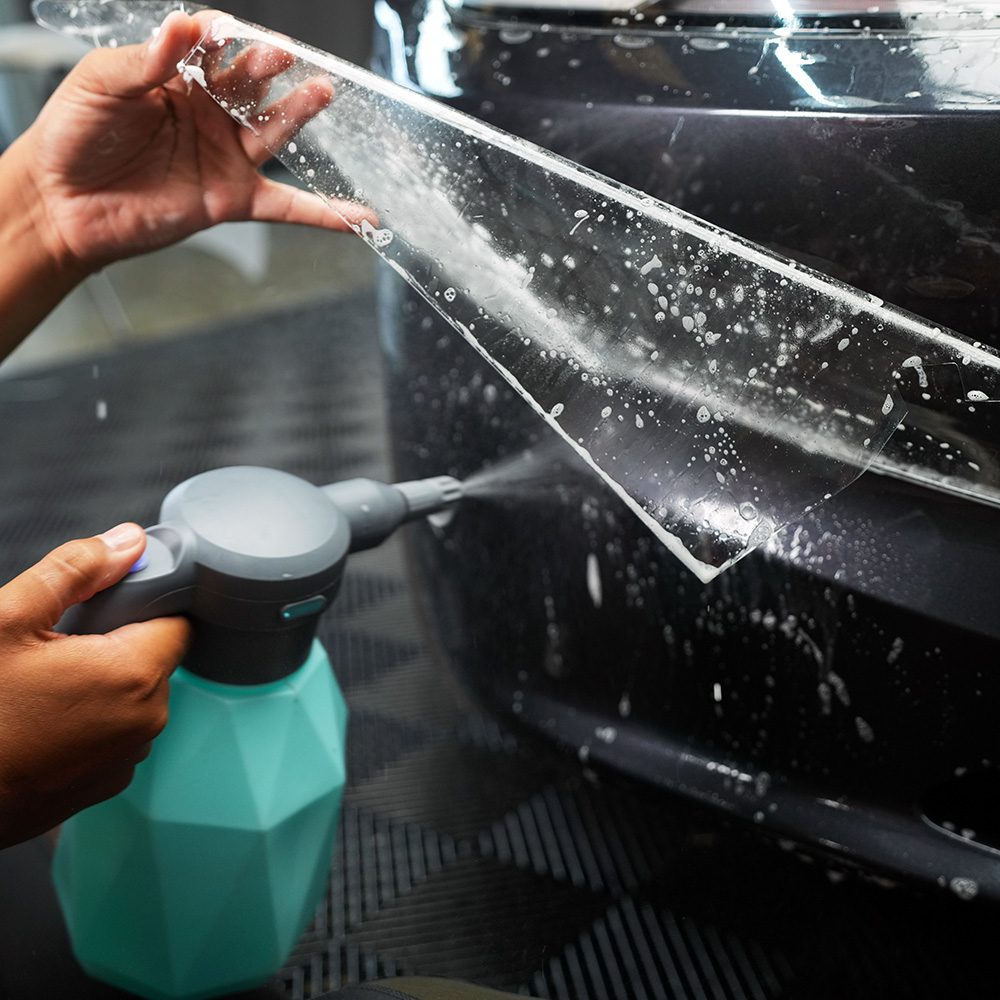
If you’re here, you’ve most likely heard of both of these recommendations from friends or family who swear by one or the other.
So, let’s cut through the noise and get to the bottom of what you need to protect your car.
Paint Protection Film (PPF) or ceramic coating?
This guide breaks down thickness, protection level, cost, installation, and real-world performance. You will know exactly what to choose by the end.
What Is Paint Protection Film?
Paint Protection Film, or PPF, is a thick polyurethane film that sits on top of your paint as a sacrificial layer.
PPF was originally developed by 3M to protect helicopter blades during the Vietnam War. It later moved into professional motorsports like NASCAR to protect logos while racing. Now it protects daily commuters. Learn more about PPF’s history here.
Key Characteristics
- Typically 8-12 mil thick
- Most films last up to 10 years
- Self-healing with heat
- Absorbs rock chips and impact
- Protects from UV damage
- Available in clear gloss, clear matte, and more recently in various colors
TL;DR: PPF physically takes damage instead of your paint.
What Is Ceramic Coating?
Ceramic coating is a liquid polymer. Most popular formulas are silicon dioxide (SiO2) based. It’s a liquid layer that bonds to your clear coat and hardens. After leveling and buffing, it forms a nano-thin layer.
You cannot see it. You can barely measure it.
Key Characteristics
• 5 to 15 microns thick
• Adds super hydrophobic properties
• Enhances gloss of the OEM paint
• Helps resist chemical etching
• Does not absorb physical impact
TL;DR: Ceramic coating is not a film. It is a bonded protective layer.
Thickness Comparison
Typical Tesla clear coat ranges from 90 to 160 microns.
After installation:
| Product | Thickness |
|---|---|
| Ceramic Coating | ~10 microns |
| PPF | ~180–200 microns |
PPF is roughly 20 times thicker. That difference matters.
Visual Comparison
What Do They Actually Protect Against?
Ceramic coating protects from:
• Bird droppings
• Bug splatter
• Acid rain
• Tree sap
• UV fading
• Light chemical stains
However, the items above will etch overtime if they aren’t cleaned off. Water spots, etching, and stains are still possible with improper care, but the coating does make it harder to damage.
It makes washing easier. reduces water spotting, and improves gloss.
However, it will not stop rock chips.
PPF protects from all the things ceramic protects from and:
• Rock chips
• Road debris
• Light scratches
• Paint transfer
• Swirl marks
• Chemical contamination
Scratches can self-heal with heat.
Installation Differences
PPF Installation
• Uses slip and tack solutions
• Film is positioned and squeegeed
• Water is removed from underneath
• Edges are locked with tack solution
• Requires precision on curves
Learning curve is moderate to high. Material cost is significant.
DIY options make it accessible.
Ceramic Coating Installation
• Paint must be extremely clean
• Often requires polishing first
• Applied in cross-hatch pattern
• Leveled with microfiber
• Buffed after
Application itself is not difficult. Paint correction is the expensive part.
DIY options make it accessible.
Cost Comparison
Professional Installation (Full Vehicle)
| Service | Typical Range |
|---|---|
| Ceramic Coating | $1,200 to $3,000 |
| Full PPF | $5,000 to $7,000 |
Material cost and labor combined drives the difference.
Budget Strategy Option
Many owners choose:
• Front-end PPF
• Ceramic coating over entire vehicle
This protects high-impact areas. It saves roughly 40 percent compared to full PPF.
High wear areas include:
- Hood
- Front bumper
- Mirrors
- Fenders
- Side mirrors
- Headlights
- Rocker panels
Hydrophobic Performance
Both products bead water and make washing easier.
However, PPF already includes a hydrophobic top coat from factory. That layer fades after about 6 months or so. Adding ceramic coating on top of PPF extends hydrophobic performance for 2 to 3 years.
Important rule: Always apply ceramic coating last. Never coat before installing PPF or vinyl. Hydrophobic surfaces prevent proper film adhesion.
DIY vs Professional
Both options can be DIY.
Ceramic DIY
• Lower material cost
• Easier application
• Paint correction is the challenge
PPF DIY
• Requires more patience
• Precision matters on curves
• Saves thousands
There is a learning curve, but it is achievable with proper instruction. Check out our courses here.
Decision Framework
Choose Ceramic Coating If:
• You want easier maintenance
• You don’t enjoy washing your car often
• You want gloss enhancement
• You are budget conscious
Choose PPF If:
• You drive highway miles
• You want rock chip protection
• You value long-term paint preservation
• You want true impact resistance
Choose Both If:
• You want maximum protection
• You plan to keep the car long term
• You want easier cleaning on top of impact resistance
Final Thoughts
Neither product eliminates washing or prevents all damage.
Protection is about managing risk.
Your choice depends on:
• Budget
• Driving habits
• Desired finish
• Long-term ownership plans
Understand the difference.
Install in the correct order.
Protect what matters to you.


