
What if charging your EV could feel a little less like waiting and a little more like experiencing the city you’re visiting?
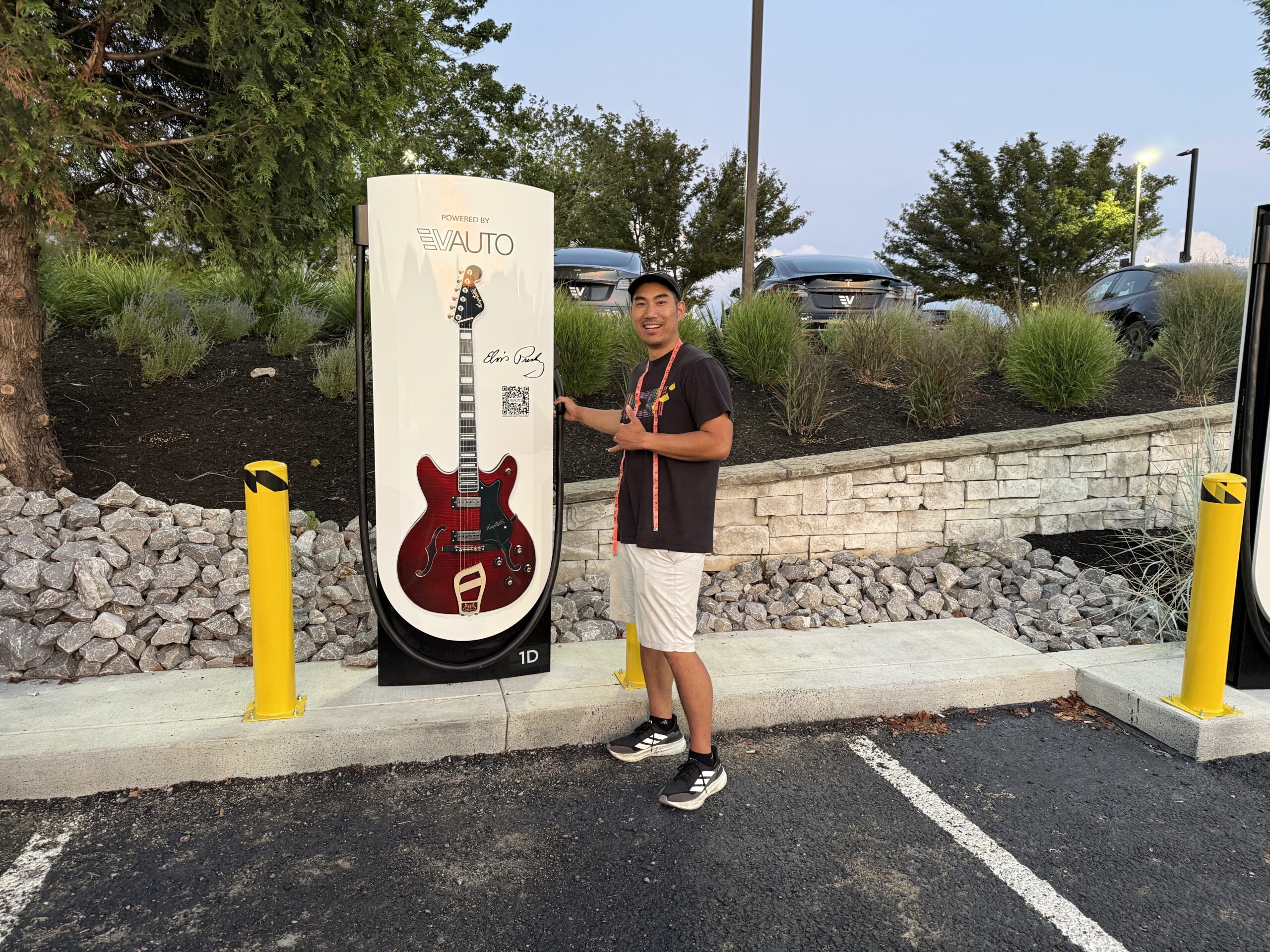
That was the idea behind one of the most unique projects we’ve taken on at DIY Wrap Club: transforming eight Tesla Superchargers at EV Auto in Brentwood, Tennessee, into custom pieces of Nashville-inspired art.
Instead of eight identical charging stalls, each Supercharger now features a different guitar inspired by a legendary artist, complete with a QR code that lets visitors learn more about the guitar and the story behind it.
The goal was simple: bring a little more joy to charging.
But getting there required custom design work, new templates, premium materials, plenty of preparation—and five very hot hours installing everything under the Nashville sun.
Turning a Supercharger Into Something Worth Visiting
EV Auto wanted its charging location to feel different.
If you’ve traveled enough, you’ve probably seen charging stations that have become destinations themselves. Someone does something unusual with them, photos start appearing online, and suddenly people want to stop there specifically to see them.
EV Auto co-founder Alex knew he wanted to create that kind of experience in Nashville.
The obvious starting point was the city itself.
Nashville and music are inseparable, so the original concept eventually evolved into something much more specific: give each of the eight charging stalls its own guitar inspired by an iconic artist.
Rather than repeating one graphic eight times, every stall would become its own design.
That made the project considerably more complicated, but also much more interesting.
Eight Chargers. Eight Unique Guitar Designs.
Working with guidance and concepts from the EV Auto team, we developed eight individual Supercharger designs.
Each one recreates an artist’s recognizable guitar across the face of the charger while still fitting within one cohesive visual system for the entire location.
The result is almost like a miniature outdoor guitar exhibit.
But there’s another layer to it.
Every Supercharger includes a QR code that visitors can scan while they’re charging. The code takes them to a dedicated page where they can learn more about the guitar, the artist associated with it, and why that particular instrument is significant.
Some of these guitars have their own histories that span decades.
Instead of standing next to a generic charger for 20 or 30 minutes, you now have something to look at, photograph, scan, and explore.
That’s exactly what we wanted this installation to become.
Designing a Kit Before We Ever Arrived in Nashville
Because this wasn’t a normal vehicle wrap, we couldn’t simply arrive with a roll of vinyl and start installing.
We first had to figure out how to wrap a Tesla Supercharger consistently.
That meant developing our own templates for the charger faces, testing the dimensions, positioning the artwork correctly, and creating pre-cut installation kits that we could bring with us to Tennessee.
It was very similar to the process we use when developing DIY vehicle wrap and PPF kits.
The design has to account for the actual shape of the surface—not just what looks good on a computer screen.
Tesla Superchargers may look flat from a distance, but the face has multiple transitions and curves. The center section is relatively flat before transitioning into concave and curved areas around the charger.
Our templates were designed around those surfaces so that each guitar would land in the correct position once installed.
By doing the templating and production work ahead of time, we were able to arrive in Nashville with eight individually designed kits ready for installation.
Using Materials Designed to Last
If we were going to put this much work into the artwork, we also wanted to make sure it could hold up.
For the printed graphics, we used Avery Dennison MPI 1105 printable vinyl, a premium film we regularly use for printed applications.
But printed vinyl alone wasn’t enough for this project.
Charging stalls live outside 24/7. They’re exposed to sunlight, weather, dirt, people, charging cables, and constant use.
In fact, when we arrived, we could already see chips, scuffs, contamination, and other wear on the existing Superchargers.
So after installing the graphics, we added another layer.
PPF Over the Entire Design
Each finished graphic was protected with STEK DYNOshield paint protection film.
Yes—we PPF’d the Superchargers.
The clear PPF sits over the printed design and acts as a sacrificial layer protecting it from everyday abuse.
That becomes especially important around the charging cable. We realized during the installation that many of the existing marks weren’t necessarily coming from vehicles—they were coming from the heavy black charging cables repeatedly contacting the charger.
With PPF covering the finished artwork, those encounters are far less likely to damage the printed graphics underneath.
It also gives the design a deep, clean gloss finish.
The end result wasn’t simply a wrapped charger.
It was a printed, laminated, and PPF-protected charging station designed for long-term outdoor use.
Preparation Matters
Before any vinyl went onto the chargers, each surface needed to be thoroughly cleaned.
And they needed it.
Years of being outside meant there was embedded contamination, grime, chips, and debris across the surfaces.
We clay barred the chargers to remove contamination before drying everything for the vinyl installation.
Normally, this type of install would happen inside our shop in a controlled environment around 70°F.
This installation was a little different.
We were working outside in Nashville with temperatures around 90°F, direct sun, and hot asphalt underneath us.
That completely changes how vinyl behaves.
Wrapping Superchargers in 90-Degree Heat
Heat makes vinyl significantly more flexible.
Usually that’s useful.
Too much heat, though, makes the film want to stretch when you don’t want it to.
And because every guitar was precisely positioned within a pre-designed template, even a small amount of unexpected stretch could throw off the alignment.
So we had to change our installation technique as we worked.
Instead of immediately conforming the vinyl around every curve, we focused on establishing the large flat face first.
One person controlled one side, another supported the opposite side, and another helped control the bottom of the graphic.
Once the center was properly positioned and anchored, we could gradually work toward the curved sections.
The objective was to let the vinyl lay naturally instead of pulling it unnecessarily.
Even then, the heat created some unexpected stretching.
That’s the reality of installing outside: sometimes you have to adapt your process to the conditions in front of you.
And it’s also why we’ll still tell anyone installing one of our DIY kits:
If you have the choice, install indoors.
We broke our own rule for this one.
The PPF Was Actually the Easy Part
Once the printed graphics were installed, we moved on to the protective layer.
Because we had also templated the PPF beforehand, the DYNOshield pieces were already cut for the charger faces.
PPF uses a wet installation process rather than the dry installation method we used for the vinyl, and surprisingly, it ended up being one of the easier portions of the project.
We positioned the film, worked the solution out in sections, followed the shape of the charger, and protected the finished artwork underneath.
One charger became two.
Two became four.
Eventually, all eight were complete.
Eight Completely Custom Tesla Superchargers
About five hours after starting, we stepped back and finally got to see the complete installation.
Eight previously identical Superchargers had turned into eight individual pieces of artwork.
And seeing them together made the concept work even better than we expected.
They’re colorful.
They’re unmistakably Nashville.
They’re interactive.
And every stall has its own personality.
You can charge next to one guitar, walk down the row and discover another, scan the QR codes, read the stories, take photos, and share your favorite.
It’s something we haven’t seen done quite like this before.
And that’s what makes this installation special.
Making EV Charging Less Boring
EV infrastructure is usually designed almost entirely around utility.
It has to work, be recognizable, and be durable.
But none of that means it has to be boring.
There are thousands of charging stations sitting in parking lots around the country that could also become opportunities to showcase the communities around them.
Nashville has music.
Another city might highlight its architecture.
A coastal location could feature local wildlife.
Another sports venue could incorporate team history.
A business could turn its chargers into an extension of its brand.
There’s an enormous blank canvas sitting in parking lots everywhere.
This project gave us a chance to show what’s possible when you treat charging infrastructure as something people can actually interact with rather than something they simply park beside.
That’s why we’re offering these Supercharger wrap services across the US.
See Them in Nashville
If you’re in the Nashville area, you can see the finished chargers at EV Auto in Brentwood, Tennessee.
Plug in, walk through all eight designs, scan the QR codes, and learn about the guitars that inspired them.
And if you take a picture while you’re there, tag DIY Wrap Club so we can see it and share it too.
This project started as an idea to make eight Superchargers a little more interesting.
It ended up becoming something completely custom: a Nashville-inspired charging experience combining design, music history, vinyl, PPF, and EV culture.
And hopefully, something that makes the next charging stop a little more fun.


